Aberdeen Art Gallery Micro Commission – How I made the prints you can still see in the city art gallery

Transformation & Anticipation at Aberdeen Art Gallery

I was recently in Aberdeen Art Gallery and was delighted to see that two of the three prints I made for them were still on show after 2 years. They’re on the 1st floor in the Oot n Aboot exhibition, which brings together pictures and stories  of local residents and their shared expeirence of living in the city.

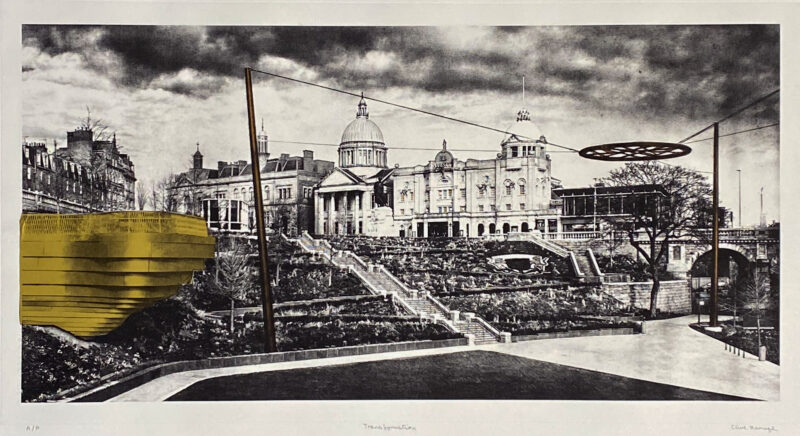
Transformation (Union Terrace Gardens)(photopolymer etching)

I’ve been asked many times how I made the 3 different prints, so here is a fairly in-depth breakdown of the entire process; from my original application for the Aberdeen Art Gallery & Museums (AAGM) commission, to getting the pictures made, framed and on the wall.

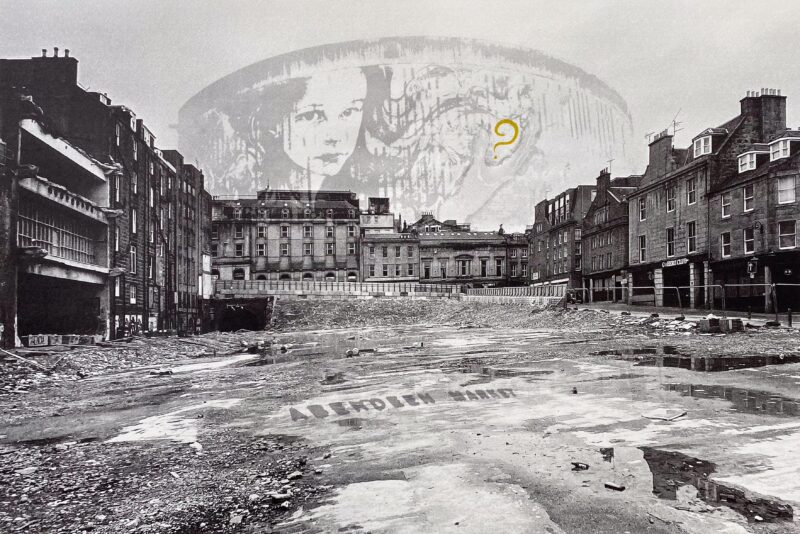
Anticipation (Aberdeen Market)
The Application

I was initially told about the AAGM Micro-commissions by a studio colleague the day before the deadline. I was in the middle of moving into my new studio and packing for a New Year trip to Crovie the following day. However, as a relative newcomer to Aberdeen and having spent many hours admiring the gallery’s fantastic collection, my interest had been piqued! I downloaded the application form as soon as she left and had a first draft written within an hour.

Applicants were asked to say something about their lived experience in the city, addressing themes that might include social justice, climate change, identity, diversity, representation, well-being and migration, while responding to something that was already part of the AAGM collection. The Micro-commissions could be small in scale and created over a short time period. I thought it could be a challenge to come up with an exciting print-based project that would test some of my recently-acquired printmaking skills, especially in screen and photopolymer printing. And, in the unlikely event my proposal was successful, I might just about manage to complete the rather ambitious project I had put together in my mind, despite having already committed to 2 solo shows and another important commission – all of which were to be fulfilled before the AAGM June deadline.

So the first day of our supposedly relaxing holiday was spent rewriting my application (with considerable editorial help from my patient and very understanding partner) and it was submitted within an hour of the deadline. Then, having never applied for anything like this before, I resignedly put the whole experience down to practice and relaxed for the rest of our trip.

John Piper’s beautiful watercolour of Dunnottar Castle which was the inspiration for my own version

Around 4 weeks later, having forgotten all about my application and while frantically finishing several paintings and working on the final preparations for my early March solo show, I received an email to say my proposal had in fact been successful. My initial elation and surprise at this great news were suddenly followed by a gut-wrenching dread that I might just have overstretched myself! But I do love a challenge and that’s exactly what the following 5 months proved to be!

The Proposal

In selecting a work from the AAGM collection as an initial reference for my own project, John Piper’s powerfully atmospheric painting of Dunnottar Castle immediately sprang to mind. Like many of his works, it perfectly captures with great drama and deceptive simplicity the beauty that can often be found even in a crumbling old building. This got me thinking about how the disintegration of one thing can lead to something new and possibly even more beautiful in its place (a painting in this instance, but also the castle itself).

From here I travelled north in my mind to Aberdeen city centre and thought of the recently opened Union Terrace Gardens and how they have helped to rejuvenate that part of the city.

I then took a short trip across the road to the recently demolished Aberdeen Market and pondered how that has provided an opportunity and also some hope that something better might arise out of the dust and rubble.

One of several photo references of Dunnottar Castle for Disintegration

I decided to produce a triptych of handmade prints exploring the theme of disintegration in relation to those three well-loved local sites. To bring these ideas into fruition I wanted to use three different printmaking techniques, which would reflect the past, present and the future in their own way.

Here are some work-in-progress images and details that I hope will shed some light on the various processes used in creating each print:

Disintegration

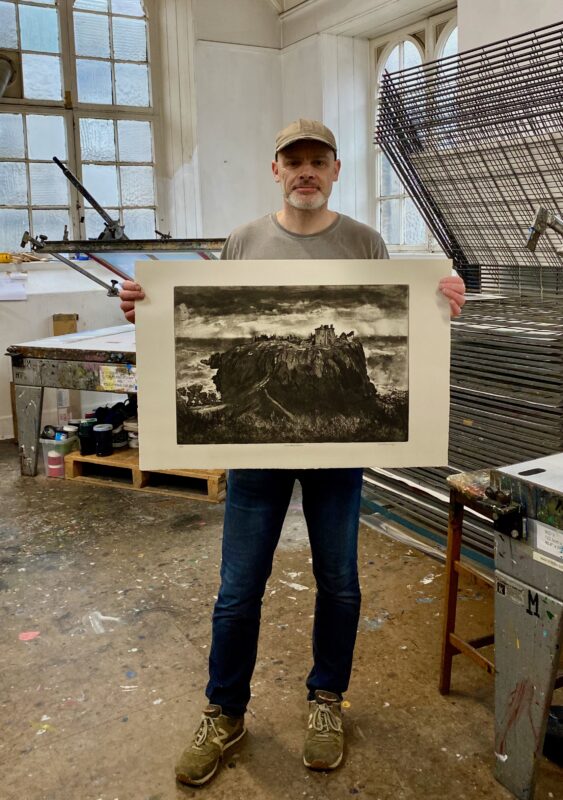
Disintegration, the first piece in the triptych, is a traditional copper-plate etching inspired by John Piper’s painting of Dunnottar Castle.

Disintegration – copper plate etching with hard ground and aquatint (including sugar lift and spit bite) on Hahnemüle etching paper.
A line etching produced on a polished copper plate with a hard ground wax resist
A first proof pulled from the above line etching
Another proof after spit biting over aquatint

Beginning to develop areas of tone across the whole image using a combination of aquatint, sugar lift and spit bite methods. Sugar lift involves painting the aquatinted areas where tone is required with a syrupy solution – Camp Coffee in this instance – then coating the whole plate with a protective varnish. The plate is then submerged in hot water and the sugar solution ‘lifts’ off the plate and through the varnish, allowing the exposed areas only to be bitten by acid to create tone. Spit bite combines gum arabic with nitric acid which is applied directly onto those aquatinted areas with a brush. Tonal washes can now be layered up by adding more or less spit bite in a painterly, watercolour-like manner.)

The etched copper plate and a proof taken at this stage of development.
Inking up the plate
Holding up the final print, ready for editioning
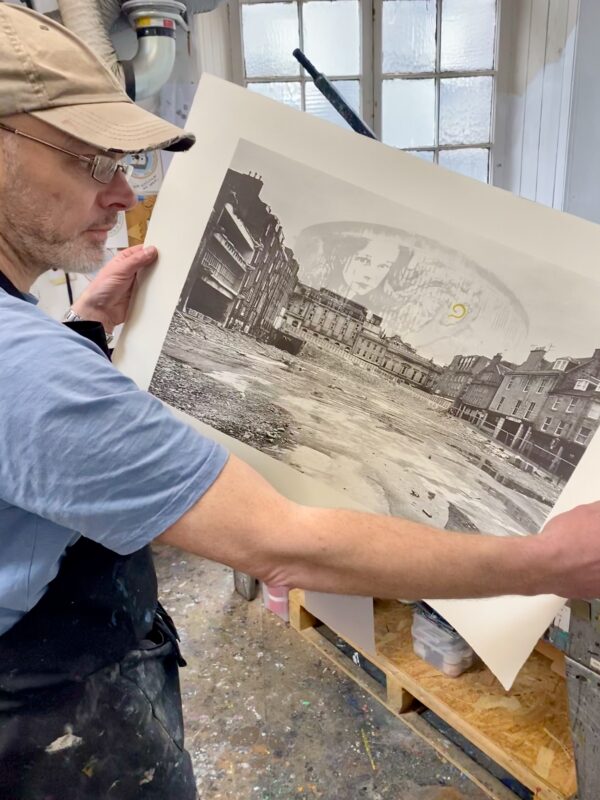
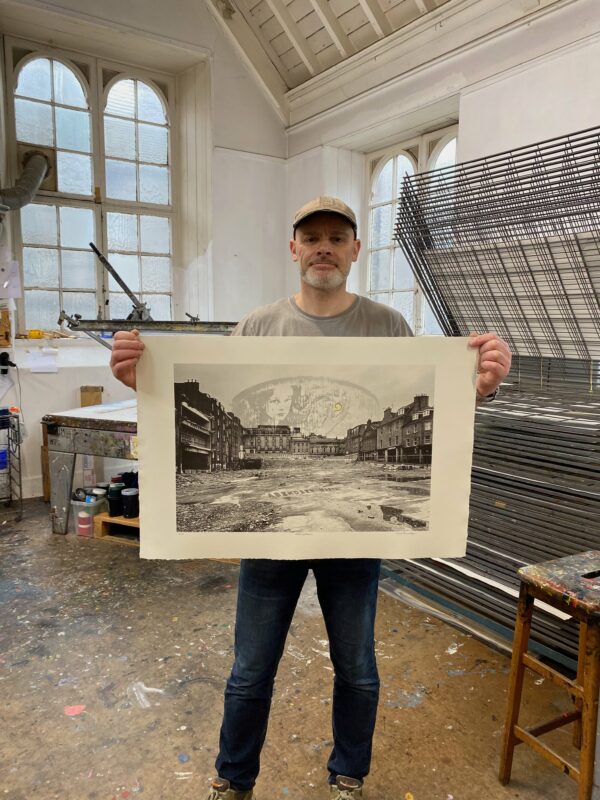
Transformation
Transformation – Photopolymer etching with chine collé and watercolour on calendered Hahnemüle etching paper

The middle piece, Transformation, depicts Union Terrace Gardens and contrasts old and new features now present in the gardens and also in the method used to create the print; in that it combines ancient etching techniques alongside photography.

(‘Calendering’ involves running the paper through an etching press under a steel plate in order to flatten out an irregular or rough surface. This results in a smoother, more photographic final image when printed using this method. Other papers could have been used, but, as this is part of a triptych, it was important to maintain continuity of tone and colour. Using the same paper for all three prints helped with that.)

A cropped photo I took with my drone that would be used to produce a photopolymer plate
The above image required further editing in Photoshop – spot the difference!
The final image is printed onto acetate to produce a film positive when exposed under UV light onto a photosensitive film, which in turn has been adhered to a plastic or steel plate.
After developing the film, it can hardened outside in natural UV light from the sun.

This was an early failed attempt using plastic as a support for the film. I used steel in the successful print which holds the film better and is more robust during the inking and printing stages.

Inking up the plate

Chine collé (a technique using coloured tissue which is sandwiched between the ink and the support paper) cut to shape and added to colour the base of the podium and the circular pendant light. The poles were hand finished with watercolour.

Chine collé paper is glued and in place prior to positioning the support paper on top before it is all run through the press. The pressure will adhere the tissue (glue side up) onto the support paper and the ink will be printed from underneath onto both surfaces.

The steel plate used as a support for the photosensitive film was cut to be slightly larger than the final image, creating a debossed ‘frame’.

The print is signed and ready to frame for the Aberdeen Art Galleries & Museums collection
Anticipation
Anticipation – Screen print on calendered Hahnemüle etching paper

Anticipation focuses on the Aberdeen Market area and poses the question: what does the future hold for this site? The imagery for this three-colour screen print was created entirely in Photoshop.

Drone photo of the old Aberdeen Market site used for the background image of the third print in the triptych.

Photoshop was used to combine a drone-captured digital image with an interpretation of the Herakut mural from the old Aberdeen Market. Three colour separations were then produced: one combining the main background image and the Old Market mural and one each for the gold question mark and the silver Aberdeen Market text.

Manipulating a photograph of the old Aberdeen Market in Photoshop. Note the removal of the lighthouse and how the hand is now upturned to hold the question mark.

After editing the background, I combined a ‘ghost’ image of the girl and old market along with the gold question mark and text in layers to create 3 colour separations to produce the screens for printing the final piece. In the end I decided to hand-paint the question mark screen separation as I wasn’t satisfied with any of the fonts I tried, including the one seen above.

Screen printed proof combining the original background image with the girl/old market and printed in one colour.
Another proof incorporating the hand-painted golden question mark

Testing different colours of ink for the Aberdeen Market text. Silver foil and glitter were also tried at this stage, but I went with a silvery grey to reflect Aberdeen as the Silver City.

The final image is signed and ready to frame for Aberdeen Art Galleries & Museums
The Micro Commission Experience

Working on the AAGM Micro-commission has been a fantastic experience as well as a great opportunity to learn. Not only because it has allowed me to develop and test my skills in traditional and photopolymer etching, as well as screen printing, but the funding that was provided by the Friends of Aberdeen Art Gallery and Museums has also enabled me to produce an entirely new stand-alone series of prints that are quite different from anything I have done before. It is also wonderful to know that my triptych has been accessioned into the AAGM permanent collection.

I would advise anyone who is interested in applying to the next round of Micro-commissions to absolutely go for it. This has been a hugely rewarding experience and has shown me what I can achieve under intense pressure.

At the Aberdeen Art Galleries and Museums Treasure Hub where I gave a talk about my Micro Commission work to the Friends of AAGM
And finally …

Finally, I would like to say a huge THANK YOU once again to the Friends of Aberdeen Art Gallery and Museums for providing the £2500 funding that enabled my Micro Commission, and many thanks also to Shona Elliot and all the staff at AAGM for their excellent support throughout. I’d also like to thank the staff at Peacock Print Studio and, in particular, James Vaas and Struan Hamilton who have both been very generous with their time, patience and expertise throughout this process.

Aberdeen Art Galleries and Museums – Micro Commission

I was initially told about the Aberdeen Art Gallery & Museums (AAGM) Micro-commissions by a studio colleague the day before the deadline. I was in the middle of moving into my new studio and packing for a New Year trip to Crovie the following day. However, as a relative newcomer to Aberdeen and having spent many hours admiring the gallery’s fantastic collection, my interest had been piqued! I downloaded the application form and had a first draft written within an hour.
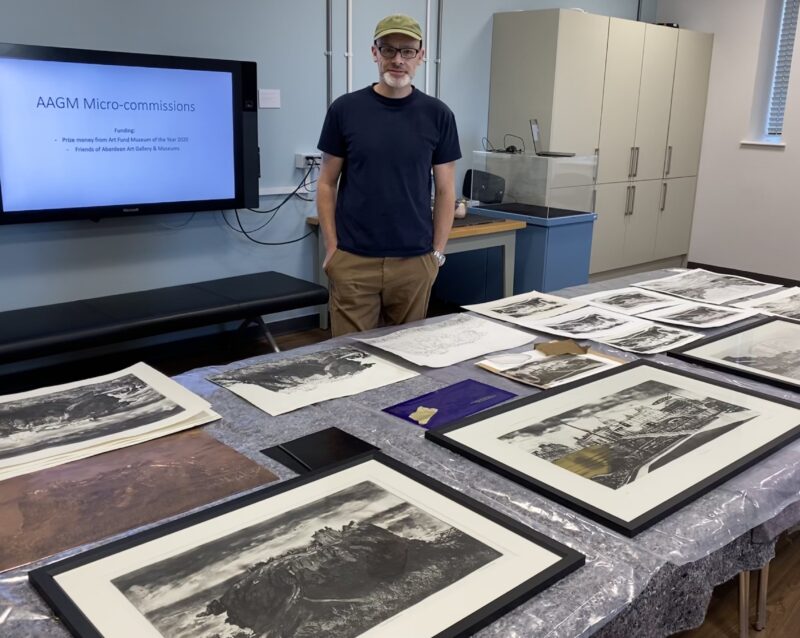
At the Aberdeen Art Gallery and Museums’ (AAGM) Treasure Hub where I gave a talk about my Micro Commission work to the Friends of AAGM

The brief

Applicants were asked to say something about their lived experience in the city, addressing themes that might include social justice, climate change, identity, well-being and migration, while responding to something that was already part of the AAGM collection.

I thought it could be a challenge to come up with an exciting print-based project that would test some of my recently acquired printmaking skills, especially in screen and photopolymer printing. And, in the unlikely event my proposal was successful, I might just about manage to complete the rather ambitious project I had put together in my mind, despite having already committed to 2 solo shows and another important commission – all of which were to be fulfilled before the AAGM June deadline!

No holiday for me … not yet anyway!

So the first day of our supposedly relaxing holiday was spent editing my application (with considerable help from my patient and very understanding partner Pam) and it was submitted within an hour of the deadline.

Having never applied for anything like this before, I resignedly put the whole experience down to good practice and relaxed for the rest of our trip.

Success!

Around 4 weeks later, having forgotten all about my application and while frantically finishing several paintings and working on the final preparations for my early March solo show, I received an email to say my proposal had in fact been successful!

My initial elation and surprise at this great news were suddenly followed by a gut-wrenching dread that I might just have overstretched myself! But I do love a challenge and that’s exactly what the following 5 months proved to be!
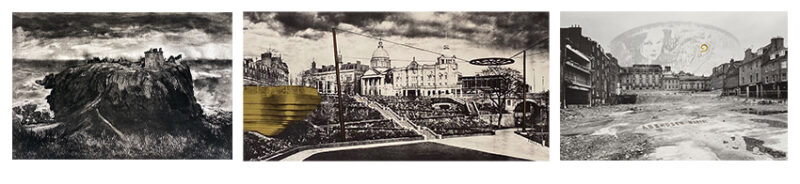
The final 3 prints that make up the triptych: Disintegration, Transformation & Anticipation. I named the triptych with a nod to the 3 institutions that feature in the middle print; namely the Central Library, St Mark’s Church & His Majesty’s Theatre, collectively known by locals as Education, Salvation & Damnation.

The Proposal

In selecting a work from the AAGM collection as an initial reference for my own project, John Piper’s powerfully atmospheric painting of Dunnottar Castle immediately sprang to mind. Like many of his works, it perfectly captures with great drama and deceptive simplicity the beauty that can often be found even in a crumbling old building. This got me thinking about how the disintegration of one thing can lead to something new and possibly even more beautiful in its place (a painting in this instance, but also the castle itself).
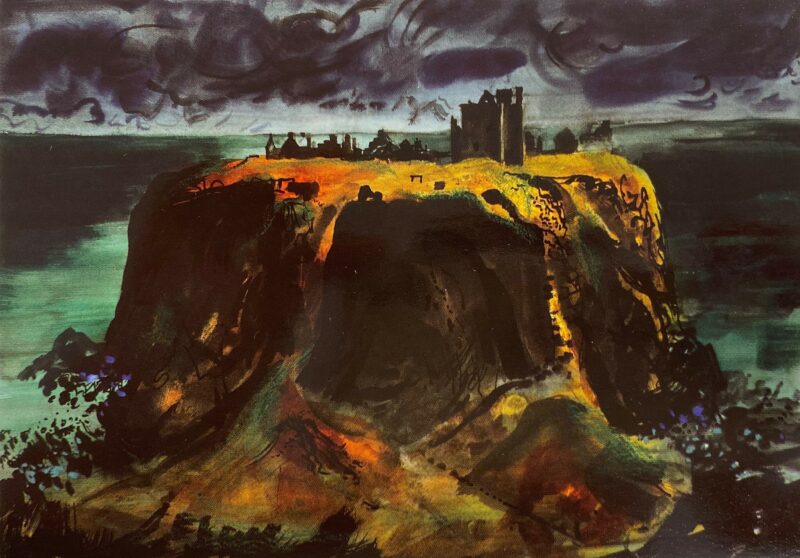
Dunnottar Castle by John Piper

From here I travelled north in my mind to Aberdeen city centre and thought of the recently opened Union Terrace Gardens and how they have helped to rejuvenate that part of the city.
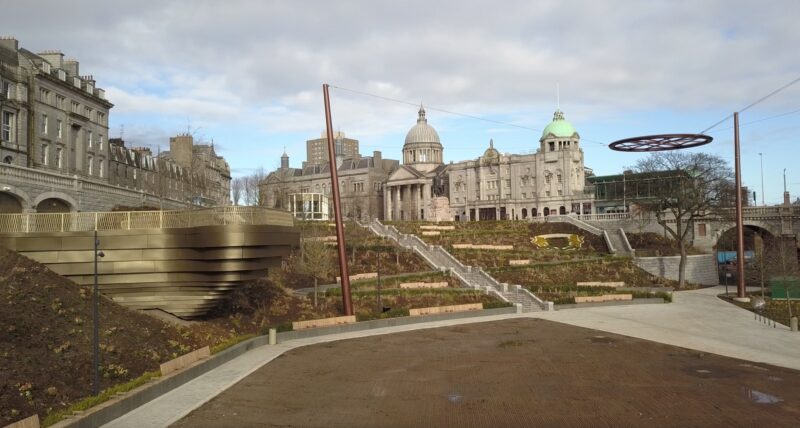
Newly reopened and rejuvenated Union Terrace Gardens (January 2023)

I then took a short trip across Union Street to the recently demolished Aberdeen Market and pondered how that has provided an opportunity (and also hope) that something better might arise out of the dust and rubble.
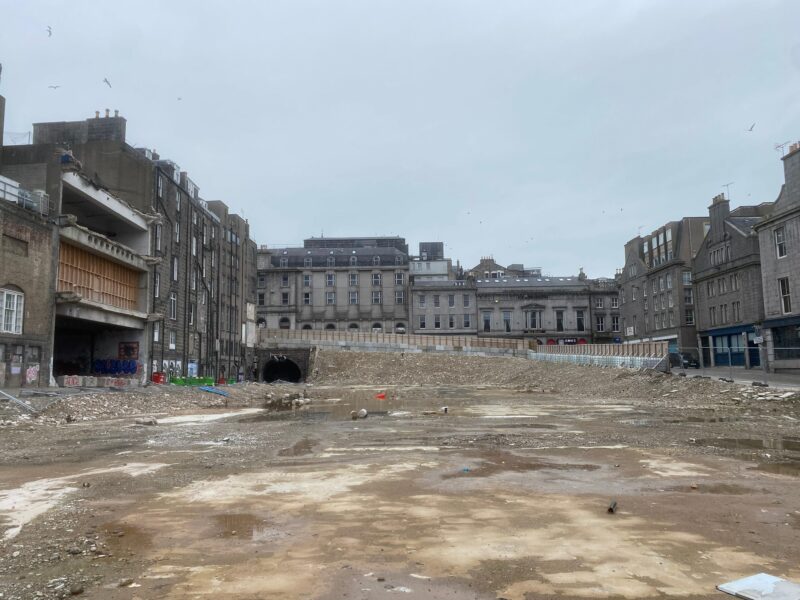
The currently vacant site of the old Aberdeen Market

I decided to produce a triptych of handmade prints exploring the theme of disintegration in relation to those three well-loved local sites. To bring these ideas to fruition I wanted to use three different printmaking techniques, which would reflect the past, present and future in their own way.

Three Different subjects printed three different ways

Disintegration

Disintegration, the first piece in the triptych, is a traditional copper-plate etching inspired by John Piper’s painting of Dunnottar Castle.

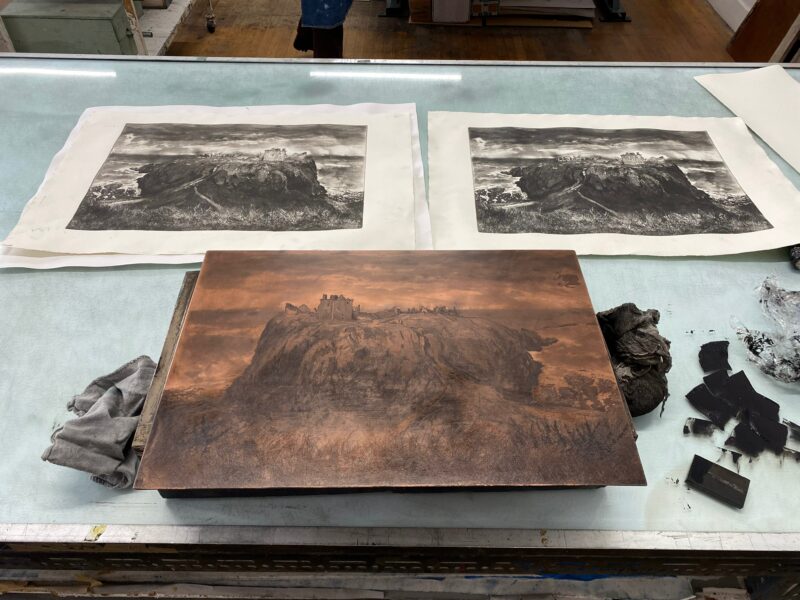
Disintegration – 40x60cm – copper plate etching with hard ground and aquatint (including sugar lift and spit bite) on Hahnemüle etching paper


Inking up the plate


Disintegration is signed and ready to deliver to Aberdeen Art Gallery when framed

Transformation

Transformation – 40x76cm – photopolymer etching with chine collé and watercolour on calendered Hahnemüle etching paper

The middle piece, Transformation, depicts Union Terrace Gardens and contrasts old and new features now present in the gardens and also in the methods used to create the print.

Chine collé tissue cut to shape for adding colour to the etching

It combines very traditional etching techniques like chine collé above to add colour  to the print …
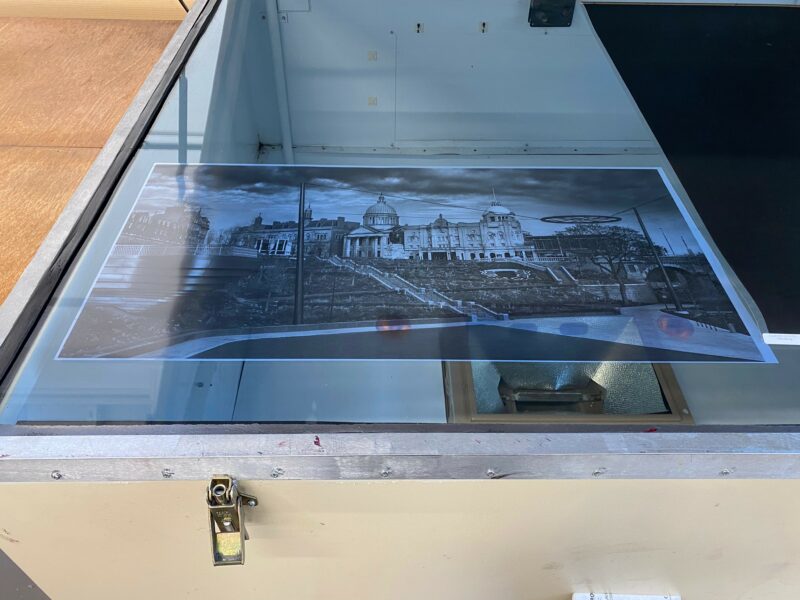
An acetate was used to expose the image onto a photopolymer-coated steel plate

… alongside methods employed in contemporary digital photography.
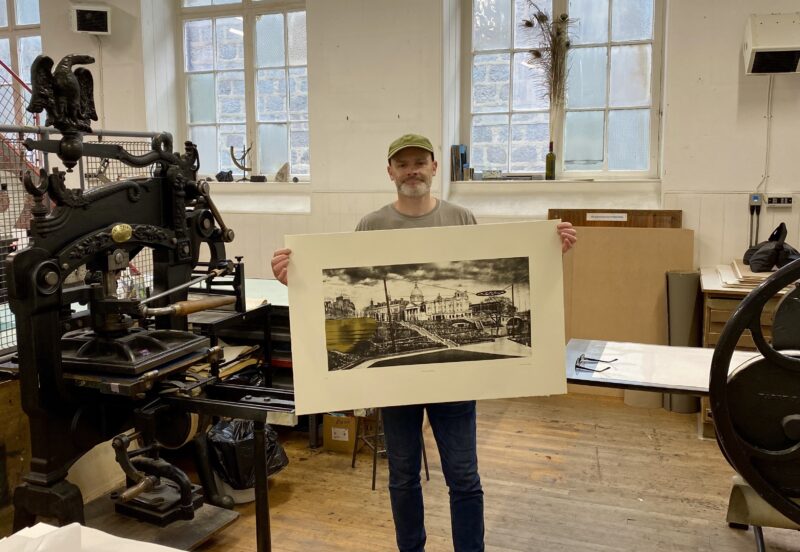
Transformation completed at Peacock Print Studio in Aberdeen and ready for the AAGM collection

Anticipation

Anticipation – 40x60cm – screen print on calendered Hahnemüle etching paper

Anticipation focuses on the Aberdeen Market area and poses the question: what does the future hold for this site?
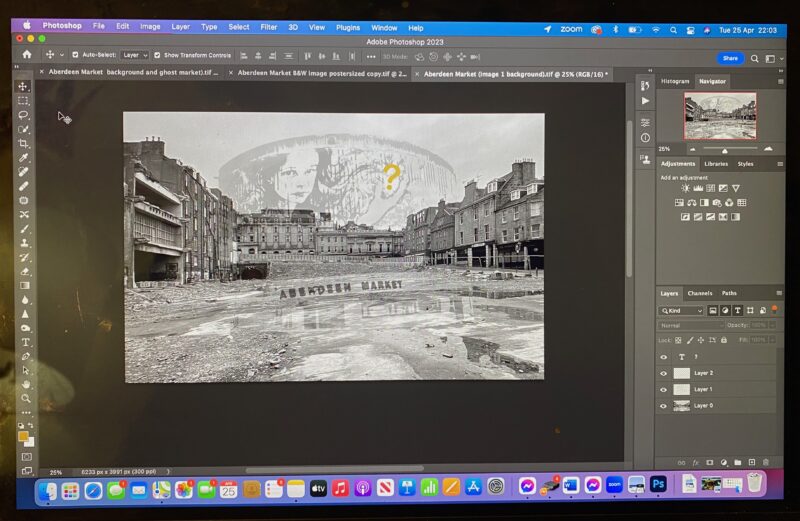
Making a composite of the various pictorial elements in Photoshop

Photoshop was used to combine a drone-captured digital image with an interpretation of the Herakut mural from the old Aberdeen Market.
A proof incorporating the hand-painted golden question mark


The final image of the triptych, Anticipation, is signed and ready to frame

The Micro Commission Experience

Working on the AAGM Micro-commission has been a fantastic experience as well as a great opportunity to learn. Not only because it has allowed me to develop and test my skills in traditional and photopolymer etching, as well as screen printing, but the funding that was provided by the Friends of Aberdeen Art Gallery and Museums has also enabled me to produce an entirely new stand-alone series of prints that are quite different from anything I have done before. It is also wonderful to know that my triptych has been accessioned into the AAGM permanent collection.
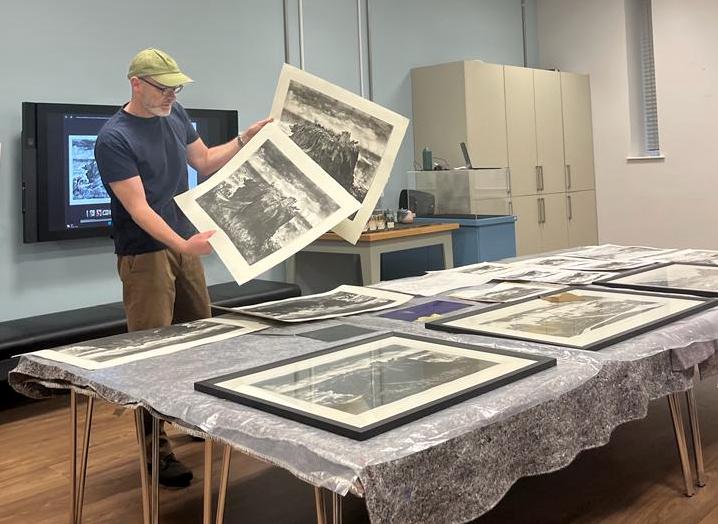
Describing the processes involved in producing each print at Aberdeen’s Treasure Hub

I would advise anyone who is interested in applying to the next round of Micro-commissions to absolutely go for it. This has been a hugely rewarding experience and has shown me what I can achieve under intense pressure.

And finally …

Finally, I would like to say a huge THANK YOU to the Friends of Aberdeen Art Gallery and Museums for providing the £2500 funding that enabled my Micro Commission, and many thanks also to Shona Elliot and all the staff at AAGM for their excellent support throughout. I’d also like to thank the staff at Peacock Print Studio and, in particular, James Vaas and Struan Hamilton who have both been very generous with their time, patience and expertise throughout this process.

I will put together another post soon where I will go into more detail about the making of each print in the triptych … watch this space!